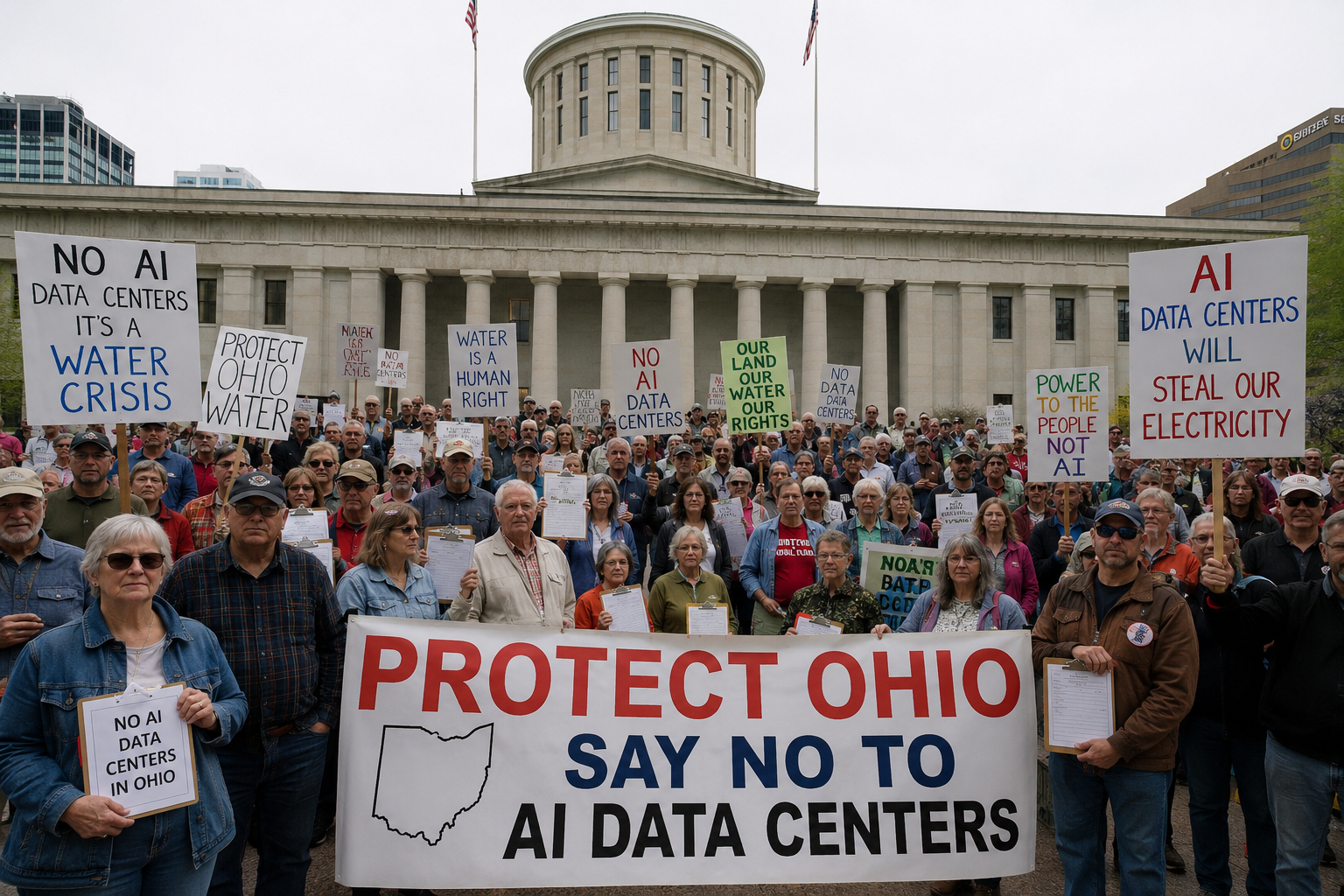
Ohio residents aren’t waiting for politicians to act — they’re going straight to the ballot box. A coalition of citizens has submitted 25,000 signatures to put a constitutional amendment on the state ballot that would ban new AI data center construction across Ohio. If successful, it would be one of the most aggressive legal barriers to AI infrastructure in American history — baked directly into the state constitution, where no future legislature can quietly undo it.
Why 25,000 Signatures Changes the Conversation
A constitutional amendment in Ohio requires petitioners to gather signatures representing at least 10% of voters from at least 44 of Ohio’s 88 counties in recent election cycles. The 25,000-signature milestone signals that this movement has genuine grassroots traction across the state — not just in one county or one urban area, but broadly. Organizers say they’re not stopping here and expect the total to grow significantly before the final submission deadline.
The constitutional route is deliberate. Organizers chose it specifically because it places the ban beyond the reach of the state legislature. Past efforts to regulate data center development through state law have stalled, been reversed, or been weakened by industry lobbying. Writing the restriction into the constitution makes it significantly harder for any single administration or legislative session to undo.
The Resource Argument at the Heart of the Fight
The numbers behind the opposition are stark. A single large-scale AI data center can consume up to 5 million gallons of water per day for cooling. In Ohio — a state with extensive agricultural land, rural communities dependent on aquifer systems, and an aging electrical infrastructure — the prospect of dozens of new facilities arriving in rapid succession raises hard questions about resource allocation. Petition supporters argue that no community should have their water table permanently depleted and their electrical grid stressed to serve corporate AI computing demands.
The electricity picture is equally concerning to critics. Data centers operate 24/7 at maximum load, creating a persistent baseline draw on regional grids. In areas where utilities are already managing seasonal peaks and aging transmission lines, adding major industrial computing loads can force grid upgrades that ultimately get passed to ratepayers — many of them farmers and rural households with no stake in AI development.
A Bipartisan Coalition Driving the Push
The petition’s support crosses partisan lines in a way that has surprised observers. Conservative property rights advocates see data center expansion as a form of corporate seizure of local resources — a government-backed or government-enabled transfer of community assets to large tech corporations. Progressive environmental groups are focused on carbon emissions, water depletion, and what they describe as the industrialization of rural Ohio. Both camps have found common cause, and that coalition is what has made the signature drive viable at scale.
Tech industry representatives and business groups have pushed back hard. They argue that constitutional bans would cost Ohio billions in investment, thousands of jobs, and its position as a competitive state for tech infrastructure. Several major tech companies have already built or announced large data center campuses in Ohio, citing the state’s central location, relatively affordable land, and existing power grid capacity. Critics of the petition say blocking data centers won’t stop AI — it will simply shift development to states with fewer restrictions.
What Comes Next
Whether the amendment reaches the ballot depends on clearing Ohio’s full signature threshold and surviving the legal challenges that would almost certainly follow. Constitutional amendments in Ohio also face a statewide vote, meaning the argument would play out in front of millions of voters — many of whom have not yet weighed in on the tradeoffs between tech investment and resource protection.
But 25,000 signatures is no longer a fringe movement. Ohio has become a key battleground in the national debate over where AI infrastructure gets built, who bears the costs, and whether communities have the right to say no. The answer from these Ohio residents is a clear and loud one.
Stay informed on the stories that matter most. Follow Your Daily Updates on Facebook and bookmark yourdailyupdates.news for breaking news and analysis.